
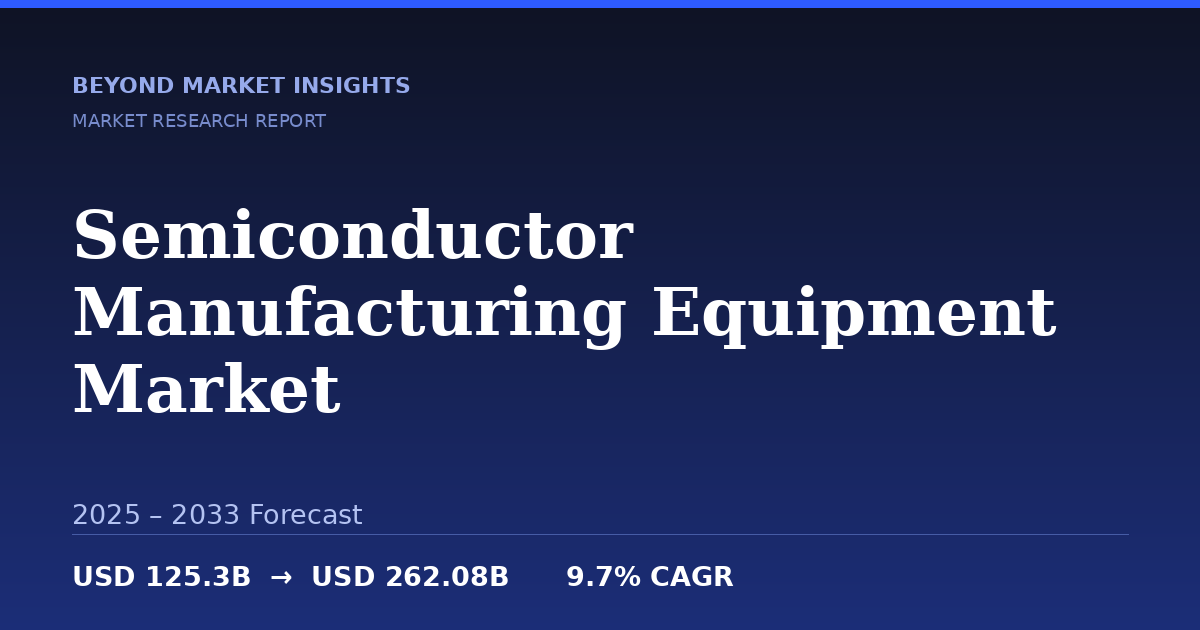
The global semiconductor manufacturing equipment market is entering a defining phase of expansion. Valued at approximately USD 125.3 billion in 2025, it is projected to reach USD 238.99 billion by 2032, advancing at a compound annual growth rate (CAGR) of 9.7% over the forecast period. That trajectory reflects both structural demand from core end-use industries and a steady shift toward higher-performance, more sustainable solutions. The sections below break down what is fuelling the growth, where the friction lies, and how the opportunity is distributed across segments and regions.
What is driving demand
Miniaturization and the adoption of advanced manufacturing processes are significant revenue-driving forces in the semiconductor manufacturing equipment (SME) market. Smaller transistor geometries lead to higher performance, reduced power consumption, and increased functional density. These benefits are valued by end users, such as smartphone manufacturers, cloud data center operators, and automotive manufacturers .
Additional momentum comes from rising demand for semiconductor across core end-use industries and product innovation and premiumisation, which together are widening the base of commercial deployments and lifting average spend per customer across the semiconductor manufacturing equipment sector.
Challenges and headwinds
The high ownership and operational costs associated with semiconductor manufacturing equipment pose a significant restraint to the market’s growth. As chip architectures become increasingly complex and technology nodes continue to shrink, moving toward 3 nm, 2 nm, and beyond, the cost of acquiring, operating, and maintaining advanced manufacturing tools has risen sharply. Cutting-edge equipment, such as extreme ultraviolet (EUV) lithography systems, developed primarily by ASML, exemplify this challenge. A single EUV lithography machine can cost over USD 200 million, making it one of the most expensive pieces of industrial equipment ever built. This means only a small group of leading-edge foundries and IDMs can afford to invest. This reduces the addressable customer base, slows equipment-purchase cycles, and delays fab-capacity expansion, factors that explicitly restrain market expansion. Suppliers are also navigating input cost volatility and supply-chain pressure.
How the market segments
The semiconductor manufacturing equipment market is analysed across 6 primary axes, Manufacturing Phase, End User, Front-end Equipment, Back-end Equipment, Equipment Type, each with a distinct growth and margin profile. Demand concentrates where measurable operational return is clearest, while faster-growing sub-segments capture incremental spend as buyer requirements evolve through 2032.
Regional outlook
Asia Pacific accounts for the largest share of the semiconductor manufacturing equipment market, anchored by concentrated manufacturing capacity, strong end-use demand, and ongoing capacity additions. North America, Europe, and LAMEA follow, each shaped by distinct regulatory, industrial, and investment dynamics. Across all regions, the balance of growth is tilting toward economies where industrialisation, infrastructure spending, and environmental regulation are expanding the addressable market through 2032.
Competitive landscape
Leading participants profiled in the research include Applied Materials Inc, ASML, LAM RESEARCH CORPORATION, Tokyo Electron Limited, and KLA Corporation. Competition centres on product performance, sustainability credentials, pricing, and the ability to serve large industrial accounts at scale.
Taken together, the data points to a market that is scaling steadily rather than spiking, rewarding participants that pair technological capability with disciplined regional execution as it advances toward USD 238.99 billion by 2032.
For complete market sizing, forecasts, and competitive intelligence, read the full Semiconductor Manufacturing Equipment Market — covering growth drivers, regional analysis, and leading company profiles through 2033.